Blog and Discussion Board have moved!

Screen Shot 2016-06-22 at 10.17.41 AM

Please make sure to visit our Facebook page at https://www.facebook.com/learningdifferencesinesl where you will see our blog and updates! This website will stay very active as a resource website, but most of the updates will be only shared on our Facebook page.

Thank you!

– Maiko Hata (Associate Head Academic Advisor/Senior Instructor I, American English Institute, University of Oregon) hata@uoregon.edu,https://www.linkedin.com/in/maikohata)

Blog is moving!

Since it takes a lot of effort to post on blog here as well as on my Facebook page, I decided to close this blog, at least for a while.

Please check out the Facebook page, https://www.facebook.com/learningdifferencesinesl, for the blog update! The new resources that are introduced on the Facebook page will continuously be added to this website under the most relevant category.

Thank you for your understanding, and see you on Facebook!

 – Maiko Hata (Associate Head Academic Advisor, American English Institute, University of Oregon – hata@uoregon.edu,https://www.linkedin.com/in/maikohata)
Posted in Uncategorized | Leave a comment | Edit

A free online course on dyslexia and foreign language teaching (shared by Gwen at PSU)

Gwen Heller Tuason, a Senior Instructor II at Portland State University, kindly shared a wonderful (free!!) online course that she’s been taking. Thank you so much, Gwen! Here’s her email, posted with her permission.

Dear Maiko,

Thank you for your excellent presentation today on ESL and learning differences.

I greatly enjoyed it and found it to be very useful.
Here is the link to the online class through Lancaster University that I’m currently taking. I think there are a number of good resources that you might be interested in.
I look forward to staying in touch and learning more about this topic–thank you for introducing us to more resources today!
Best regards,
Gwen

Gwen Heller Tuason

Senior Instructor II
Intensive English Language Program
Portland State University
503-725-2424
 – Maiko Hata (Associate Head Academic Advisor, American English Institute, University of Oregon – hata@uoregon.edu,https://www.linkedin.com/in/maikohata)

Workshop at Portland State University

I had so much fun today! I was invited by the Intensive English Program at Portland State University to speak about supporting ESL students with learning differences (in Intensive English Programs, to be specific).

Thank you to everyone who attended my workshop! Please let me know if you have any questions, and I look forward to keeping in touch 🙂

 – Maiko Hata (Associate Head Academic Advisor, American English Institute, University of Oregon – hata@uoregon.edu,https://www.linkedin.com/in/maikohata)

UO Forum on Disability Awareness – Friday, 5/6

There is a University of Oregon forum on May 6 “to raise awareness and increase inclusivity for people with disabilities on the UO campus.” I called the organizers and, yes, it’s open to anyone! (faculty and staff members as well as students and community members) and no, we don’t even need to register!

  • More info: http://gtff.net/Disability
  • When: Sessions start at 2:00 pm, Friday, 5/6. The last session (a movie viewing) ends at 8:00 pm.
  • Where: Straub Hall, University of Oregon
  • What: Workshops include “Bias 101”, “Academic Accommodation Basics”, “Mental Health and Disability”, “Universal Course Design”, and “Tech and Resources”, and more!
  • Who: Teachers, staff members, anyone! People leading the sessions are from AEC (Hilary! James Bailey!), Counseling Center, TEP, Affirmative Action… the list goes on.

Hope to see some of you there?

– Maiko Hata (Associate Head Academic Advisor, American English Institute, University of Oregon – hata@uoregon.edu,https://www.linkedin.com/in/maikohata)


LDs, IEP students and FERPA

Becki Quick, an Instructor at the American English Institute, University of Oregon, is investigating FERPA regulations in the context of IEP classes with students with Learning Differences. Here’s the question she’ll be looking into, and we wanted to see if there’s anyone out there who might have related questions that we might be able to work on as well.

  • Can instructors pass on concerns/observations of students who may self-diagnose with a LD, or students instructors suspect have a LD, to other instructors of the same student? The motivation being to trade strategies/suggestions for more effective teaching instruction for those students. (Would it be acceptable (a) for Advisors to share the placement and the new teacher for the student with the previous teacher who wants to pass on the information; (b) for the previous teacher to contact the new teacher and disclose strategies and concerns with the new teacher, with the hope that would help the student?)
  • Does this violate FERPA and/or create questionable novice diagnoses of students?
  • Do you have a FERPA-related question for sharing student information regarding LDs?

Let us know by commenting here if you have any questions or insight on this. Thank you!

– Becki Quick (Instructor, American English Institute, University of Oregon -bquick@uoregon.edu)
– Maiko Hata (Associate Head Academic Advisor, American English Institute, University of Oregon – hata@uoregon.edu,https://www.linkedin.com/in/maikohata)


Workshop ppt “Teaching foregin languages to students with learning differences”

I found this wonderful Powerpoint slides by Dr. Hecker of Landmark College titled “Teaching foreign languages to students with learning differences”. It outlines what difficulties different LDs can cause and “Best practices top 12” list. It even has some articles citations that can serve as a brief bibliography. I enjoyed reading this a lot, and am definitely incorporating some of the tips into my presentations.

As always, I will put this on the website (https://learningdifferencesinesl.wordpress.com/), and it will be under Courses and Webinars (https://learningdifferencesinesl.wordpress.com/resources/courses/) .

– Maiko Hata (American English Institute, University of Oregon – hata@uoregon.edu, https://www.linkedin.com/in/maikohata)

Ministry of Education in Japan creates a guide for supporting students with disabilities

Japanese post alert! Japanese Ministry of Education, Culture, Sports, Science and Technology has announced that they are working on a guideline on accommodations for universities in order to support students with disabilities. I so want the guideline when it’s ready!

They will be distributed to universities, and will include how to analyze their needs and support individuals via meetings etc.

But, the most fascinating part about this article is the numbers. Compared to 2006, in 2014 the number of students with disabilities at universities, colleges and technical colleges has tripled from 4,937 to 14,127. The number for developmental disabilities and mental illness has increased by ten fold, from 506 in 2006 to 5,866.

Glad this has picked up momentum in Japan!!!

– Maiko Hata (American English Institute, University of Oregon – hata@uoregon.edu, https://www.linkedin.com/in/maikohata)

 

EnglishUSA Newsletter on IEP students with disabilities

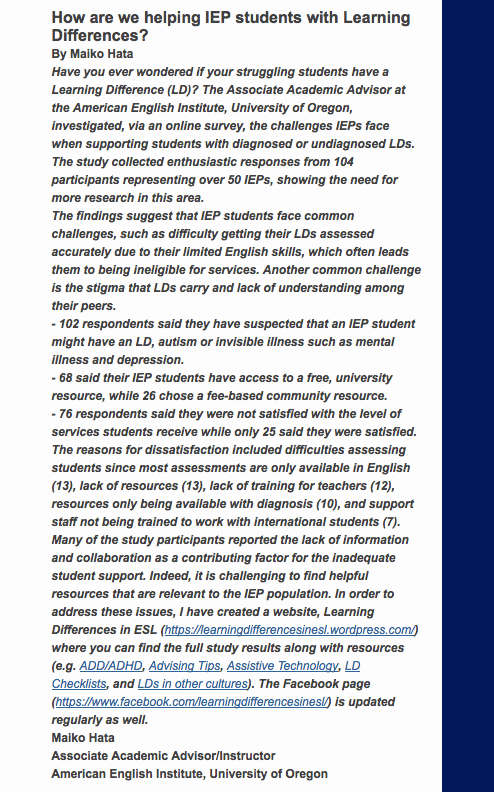
A few weeks ago, I was asked to write a piece about my study in which I investigated how IEPs are supporting students with Learning Differences/disabilities (LDs). It just came out, along with two other pieces on the topic of supporting IEP students with disabilities. Check them out! (I hope you can see it even if you are not an EnglishUSA member. In case you cannot, I am pasting the screenshot of my short article.)

Screen Shot 2016-04-08 at 8.34.18 AM

– Maiko Hata (American English Institute, University of Oregon – hata@uoregon.edu, https://www.linkedin.com/in/maikohata)